


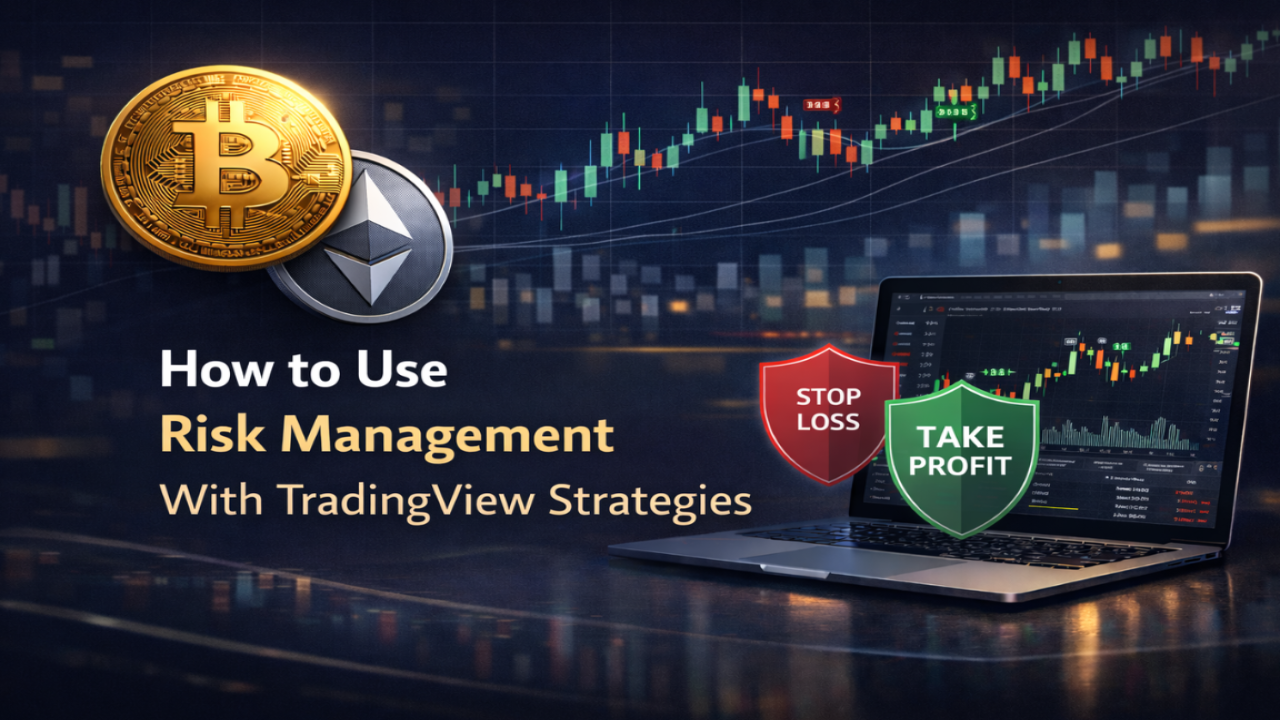
How to Use Risk Management With TradingView Strategies
Introduction
A trading strategy can look impressive on a chart, but that does not mean it is safe to trade.
This is one of the biggest lessons beginners learn in crypto trading. A setup may give clean entry and exit signals. It may seem accurate on TradingView. It may even look strong in backtesting. But if there is no clear risk management behind it, even a good-looking strategy can become dangerous once real money is involved.
That is why risk management matters so much.
In simple terms, risk management is the process of controlling how much you can lose, how you size your trades, where you place your stop loss, how you plan your take profit, and how you protect your account from emotional decisions. It is not the glamorous side of trading, but it is often the difference between a trader who survives long enough to improve and a trader who burns out quickly.
This article is educational content only. It is not financial advice, and it does not guarantee profits. The goal is to help you understand how to use risk management with TradingView strategies in a practical, beginner-friendly way.
What You Will Learn in This Guide
By the end of this article, you will understand:
- why risk management matters just as much as strategy signals
- how to use TradingView for charting, indicators, alerts, backtesting, and strategy testing
- how stop loss, take profit, and position sizing work together
- the difference between using risk management in spot trading and futures trading
- how leverage changes risk, especially in crypto trading
- common mistakes traders make when they focus only on entries
- a simple step-by-step framework for applying risk management to TradingView strategies
If you are learning technical analysis, support and resistance, trend-based trading strategies, or strategy testing, this topic deserves your attention before you risk more capital.
Why This Topic Matters
Many traders spend most of their time searching for the “best” entry.
They compare indicators, change settings, test support and resistance zones, and study charting patterns on TradingView. While that can be useful, it often creates an imbalance. The trader becomes highly focused on how to get into a trade and not nearly focused enough on what happens after the trade begins.
That is where the real risk starts.
A trade is not just an entry signal. It is also:
- how much of your account is exposed
- where the stop loss goes
- where the take profit makes sense
- whether the reward is worth the risk
- whether the position size matches your plan
- whether you can stay disciplined if the market becomes volatile
In crypto trading, this matters even more because volatility can be sharp. Price can move quickly, especially in futures trading. A strategy that feels manageable in backtesting can become stressful in live conditions if risk management is weak.
Good traders do not just ask, “Is this a good setup?”
They also ask:
- “How much can I lose if I am wrong?”
- “Is this stop loss realistic?”
- “Am I using too much leverage?”
- “Does this strategy fit spot trading better or futures trading better?”
- “Have I tested the risk, not just the signal?”
That mindset shift is important. TradingView strategies can help you identify opportunities, but risk management is what gives those opportunities structure.
Core Explanation: What Risk Management Really Means
Risk management is the framework that protects your trading capital while allowing you to participate in the market.
It is not one single rule. It is a collection of decisions that work together.
Risk management includes:
Position sizing
This is how large your trade is relative to your account. Even a strong setup can be risky if the position size is too large.
Stop loss placement
A stop loss is the level where you exit a trade to limit losses. It helps prevent a small loss from becoming a large one.
Take profit planning
A take profit is the level where you close part or all of a trade to lock in gains. It gives structure to the exit, not just the entry.
Risk-to-reward thinking
This means comparing how much you are risking to how much you expect to gain. A trade with a poor reward relative to the risk may not be worth taking.
Market condition awareness
Not every strategy works in every environment. Some TradingView strategies perform best in trends, while others work better in ranges. Risk management includes knowing when conditions are unfavorable.
Emotional control
Even a well-designed strategy can fail if the trader keeps moving stop loss levels, overtrading, or using leverage emotionally.
In other words, risk management is not separate from the strategy. It is part of the strategy.
Key Concepts Beginners Need to Understand
Before applying risk management to TradingView strategies, it helps to understand a few core terms.
Trend
A trend is the overall direction of price. In an uptrend, price tends to form higher highs and higher lows. In a downtrend, price tends to form lower highs and lower lows. Many trading strategies work better when aligned with the trend.
Volatility
Volatility refers to how much price moves and how quickly it moves. Crypto markets are known for high volatility, which means stop loss and take profit levels need to account for sudden moves.
Support and Resistance
Support is an area where price often slows down or bounces after falling. Resistance is an area where price often struggles to move higher. These levels are useful for both entry and exit planning.
Entry and Exit
An entry is where the trade begins. An exit is where the trade ends. A strategy that only focuses on entry signals is incomplete.
Stop Loss
A stop loss is a predefined point where you exit a losing trade. It is one of the most important tools in risk management.
Take Profit
A take profit is a predefined point where you lock in gains. Some traders use fixed targets, while others trail their exits based on indicators or structure.
Leverage
Leverage allows you to control a larger position with a smaller amount of capital. It can magnify gains, but it also magnifies losses.
Margin
Margin is the capital required to support a leveraged position in futures trading. If losses become too large relative to margin, liquidation risk increases.
These concepts are essential because TradingView strategies are only useful when they are connected to realistic trade management.
How TradingView Fits Into Risk Management
TradingView is not just for finding entries. It can also help traders build a more disciplined risk framework.
Charting
TradingView charting helps traders study trend structure, support and resistance, candle behavior, and volatility. These are all useful when deciding whether a stop loss or take profit level makes sense.
Indicators
Indicators can support strategy decisions, but they should not replace judgment. For example, moving averages may help define trend, while ATR can help estimate volatility for stop loss placement.
Alerts
Alerts help traders stay organized. Instead of reacting emotionally to every candle, traders can set alerts for key levels, trend conditions, or strategy signals and respond more deliberately.
Backtesting
Backtesting allows traders to see how a strategy would have behaved on historical data. This is useful, but it should not be used only to measure profit. It should also be used to study drawdown, losing streaks, and how the stop loss and take profit logic performs.
Strategy Testing
Strategy testing on TradingView becomes far more meaningful when risk management rules are included. A strategy that looks great without realistic stops, fees, or position sizing can give a misleading impression.
TradingView is a powerful platform, but the real value comes from how thoughtfully you use it.
Spot vs Futures: Why Risk Management Changes
Risk management applies to both spot trading and futures trading, but the consequences are different.
Spot Trading
In spot trading, you buy and hold the actual asset. If price goes against you, the position loses value, but there is generally no forced liquidation in standard spot markets.
This makes spot trading simpler for beginners because:
- the structure is easier to understand
- there is usually less pressure than leveraged trading
- position sizing is often easier to manage
- stop loss decisions are still important, but liquidation risk is lower
That said, spot trading still requires discipline. A weak trade can still cause meaningful losses if the position size is too large or if the trader ignores the exit plan.
Futures Trading
Futures trading introduces contracts, leverage, margin, and liquidation risk.
This changes everything.
With futures trading:
- small price moves can have a bigger effect on your account
- poor position sizing becomes more dangerous
- emotional mistakes become more expensive
- stop loss placement becomes even more important
- overusing leverage can destroy a good setup
A TradingView strategy that looks manageable in spot can become very risky in futures if the leverage is too high or the trader has not accounted for volatility properly.
For beginners, this is why futures should be approached carefully. The signal may be the same on the chart, but the risk profile is not.
Common Mistakes to Avoid
Focusing only on the entry
This is probably the most common mistake. Traders want the perfect signal, but they do not define how much they are risking or where they will exit if wrong.
Using stop losses that are too tight
A stop loss that is too close may get hit by normal volatility. Risk management is not about placing the smallest stop possible. It is about placing a logical stop.
Taking oversized positions
Even a good TradingView strategy can fail badly if the position size is too large relative to the account.
Ignoring market conditions
A strategy that performs well in a trend may struggle badly in choppy price action. Risk management includes avoiding poor environments, not just managing active trades.
Misusing leverage
Leverage is one of the fastest ways to turn a manageable loss into a major one. It should be treated with caution, not excitement.
Trusting backtesting without context
A backtest may show good results, but traders also need to review drawdown, trade frequency, losing streaks, and how realistic the stop loss and take profit assumptions are.
Moving stops emotionally
Changing the stop loss just because the trade feels uncomfortable usually weakens discipline. A risk plan should be defined before entry, not rewritten under pressure.
Risk Management Tips That Actually Matter
Good risk management is often simple, but not always easy.
Here are practical ideas that matter across most TradingView strategies:
Risk a small portion of capital per trade
Many traders use a fixed small percentage or a fixed amount they are comfortable losing. The exact number depends on the trader, but the principle is more important than the number: one trade should not be able to damage the account heavily.
Place the stop loss where the trade idea becomes invalid
A stop loss should not be random. It should sit at a level where the original technical analysis idea no longer makes sense.
Use take profit levels that reflect structure
Take profit targets often make more sense near resistance, prior highs, measured moves, or planned reward-to-risk targets than at arbitrary numbers.
Respect volatility
A strategy that trades a volatile crypto asset needs more breathing room than one trading a calmer chart. ATR and candle structure can help here.
Lower size when using leverage
If leverage is involved, position size should still be controlled carefully. Leverage does not remove the need for discipline.
Review losing trades without emotion
Losing trades are not automatically bad trades. Sometimes the setup was valid and the market simply did not follow through. Review the process, not just the outcome.
A Practical Step-by-Step Guide
Here is a beginner-friendly process for applying risk management to TradingView strategies.
Step 1: Define the strategy rules clearly
Before thinking about risk, know what the strategy actually is.
For example:
- trend direction based on moving averages
- entry after a pullback into support
- confirmation from RSI or candle close
- stop loss below recent swing low
- take profit at the next resistance or fixed reward-to-risk target
If the strategy rules are vague, risk management becomes vague too.
Step 2: Identify where the trade idea fails
This is where the stop loss usually belongs.
If you are buying support in an uptrend, the stop may belong below the support zone or swing low. If price breaks that area, the trade idea may no longer be valid.
Step 3: Measure the risk before entering
Ask a simple question: how much am I willing to lose if this trade fails?
Once you know the stop distance, you can size the position more responsibly. The stop loss should define the size, not the other way around.
Step 4: Plan the take profit in advance
Do not enter without an exit idea.
The take profit can be based on:
- resistance levels
- a multiple of the risk
- trend continuation rules
- a partial take profit plus a trailing stop
The exact approach may vary, but having no plan is usually worse than having a simple plan.
Step 5: Check whether the trade fits the market condition
Is the market trending or ranging? Is volatility unusually high? Is the setup clear, or are you forcing it?
Not every signal deserves execution.
Step 6: Backtest the full risk model
When using TradingView for backtesting or strategy testing, include the stop loss and take profit logic in the review. Study:
- win rate
- average loss
- average gain
- drawdown
- losing streaks
- whether the strategy works better in certain conditions
A strategy is not strong just because it wins often. It should also manage losses well.
Step 7: Forward test before increasing size
After backtesting, try the strategy in paper trading or with very small exposure. This helps reveal emotional problems, execution issues, and whether the risk plan feels realistic in live conditions.
Step 8: Stay consistent
The biggest benefit of risk management appears over time. It helps traders survive bad periods, stay stable through volatility, and give their strategy a fair chance to prove itself.
Beginner-Friendly Example
Imagine a trader is using a TradingView strategy that buys when price is above the 200 EMA and pulls back to support.
Without risk management, the trader simply enters every signal with the same large size and hopes for the best.
With risk management, the process becomes more structured:
- the trader checks whether the broader trend is still intact
- the stop loss is placed below the recent swing low
- the position size is adjusted based on the distance to the stop
- the take profit is planned near the next resistance zone
- the trader avoids taking the setup if volatility is too extreme
The chart may look similar in both cases, but the outcome over time can be very different.
The second trader is not relying only on the signal. They are using the signal inside a process.
That is the real role of risk management.
Final Conclusion
Using risk management with TradingView strategies is not optional if your goal is to trade more responsibly. It is one of the most important parts of turning technical analysis into a real process.
A TradingView strategy can help with charting, indicators, alerts, backtesting, and strategy testing. It can help identify trends, support and resistance, and possible entry and exit points. But without clear stop loss placement, take profit planning, position sizing, and respect for volatility, even a promising strategy can become dangerous.
This is especially true in crypto trading, where futures trading, leverage, and fast price movement can amplify small mistakes.
The key lesson is simple: a strategy tells you where an opportunity may exist, but risk management tells you how to survive it.
A practical next step is to choose one TradingView strategy you already use, then review it through a risk-management lens. Ask where the stop loss belongs, how the take profit should be planned, how much of the account is at risk, and whether the setup fits spot trading or futures trading. That process may not feel exciting, but it is one of the strongest habits a trader can build.
FAQ Section
1. Why is risk management important when using TradingView strategies?
Because a strategy signal alone is not enough. Risk management helps define position size, stop loss, take profit, and acceptable downside so that one bad trade does not damage the account too heavily.
2. Does TradingView handle risk management automatically?
TradingView can help with charting, alerts, backtesting, and strategy testing, but the trader still needs to define the risk rules. The platform is a tool, not a replacement for judgment.
3. What is the best stop loss method for beginners?
There is no universal best method, but beginners usually benefit from placing the stop loss where the trade idea is clearly invalid, such as below support or below a recent swing low in a long setup.
4. Is risk management different in spot and futures trading?
Yes. The core ideas are similar, but futures trading introduces leverage, margin, and liquidation risk, which make risk management even more critical.
5. Should I use leverage with TradingView strategies?
Leverage should be approached carefully. It can increase both gains and losses. If you are still learning risk management, strategy testing, and emotional discipline, caution is usually the better path.
6. What should I check in a backtest besides profit?
Look at drawdown, average loss, average gain, losing streaks, trade frequency, market conditions, and whether the stop loss and take profit rules were realistic.
7. Can a good risk plan make a weak strategy profitable?
Not necessarily. Risk management does not magically fix a poor strategy, but it can reduce damage, improve consistency, and help the trader evaluate the strategy more honestly.
8. What is the simplest way to improve risk management today?
Start by defining your stop loss before entering, reducing position size, and refusing to take a trade unless the risk and exit plan are already clear.

Comments (0)
No comments found